
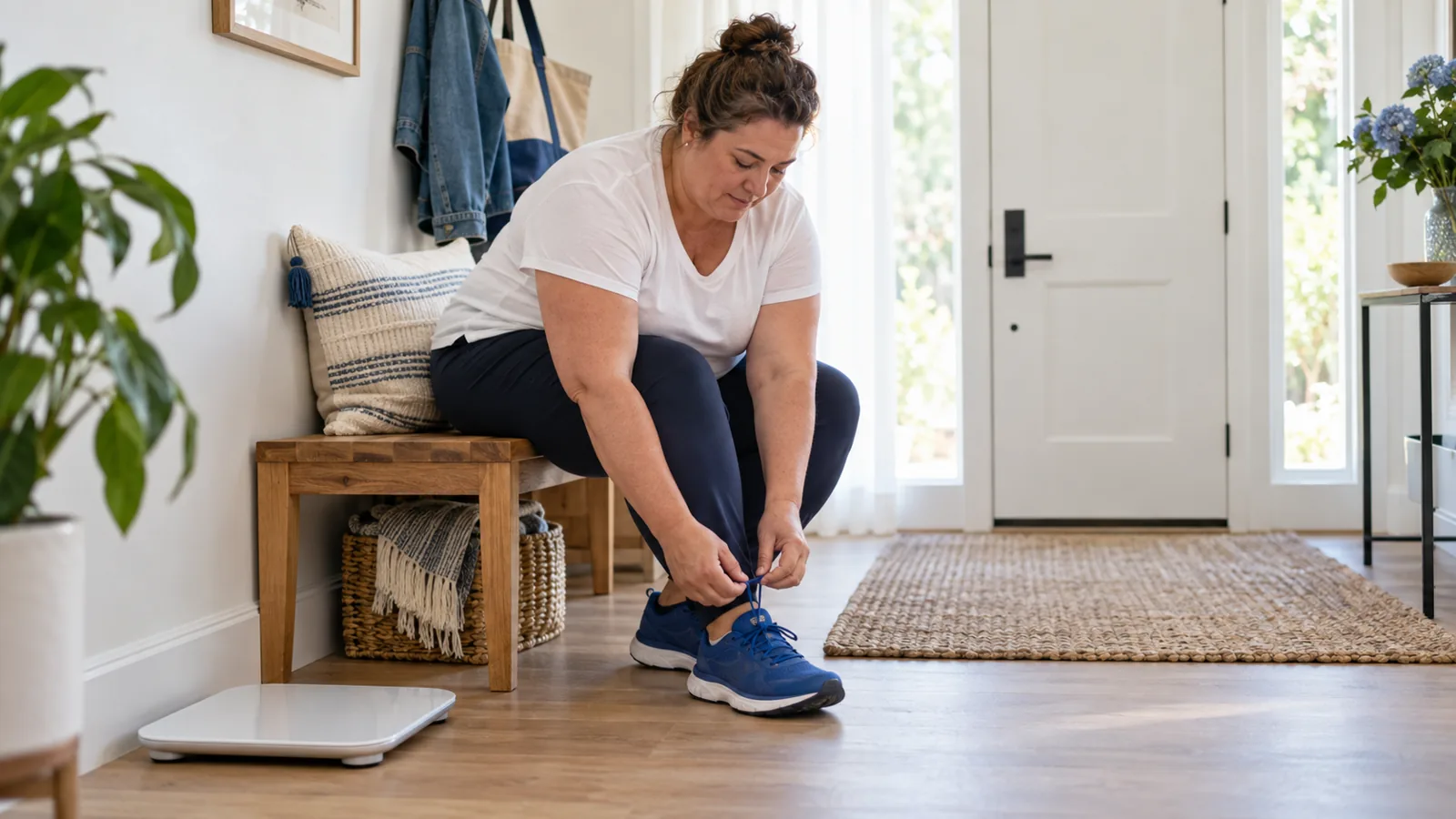
The scale has stopped moving. Here is how to separate the questions, what to prepare for your next appointment, and where everyday movement realistically fits.
Key takeaways
- A slower weight trend is a reason to review the plan with your prescriber, not to change treatment on your own.
- A few unchanged weigh-ins is not the same as the sustained pattern researchers describe as a plateau.
- Bring a timeline, your treatment experience, eating and drinking, and a picture of everyday activity to the next appointment.
- Movement supports health and routine; no step count or app can promise to restart weight loss.
The scale was moving. Now it is not. It is understandable to wonder whether your medication has stopped working—or whether you should eat less, exercise harder or change something immediately.
A slower trend is a reason to review the plan, not to make a medication change on your own. Weight-loss responses vary, and treatment decisions belong with your prescriber. Movement can support health and a sustainable routine, but no workout or app can promise to restart weight loss. NIDDK guidance on weight-management medications
First, separate two different questions
"I have not lost weight since starting" is not the same as "I lost weight and then the trend slowed."
For the first, your clinician needs the treatment timeline and your experience so far. For the second, the question is how the longer-term trend fits with your current plan. Neither can be answered reliably by comparing your progress with a stranger's before-and-after post.
Write down when you started, the treatment schedule your prescriber gave you, and what has actually changed. That gives the next conversation a better starting point than "it is not working."
Is a few unchanged weigh-ins a plateau?
Not necessarily. In a post-hoc analysis of the SURMOUNT tirzepatide trials, researchers assessed sustained patterns across 12-week intervals—not a few days of unchanged readings. That research definition is not a rule telling you to wait 12 weeks before asking for help. SURMOUNT plateau analysis
The analysis included selected participants who adhered to treatment and achieved at least 5% weight loss by the study endpoint. Its results should not be treated as a forecast for everyone starting medication.
The practical lesson is simpler: bring a trend and a timeline, not just the most frustrating number of the week.
Why can weight loss slow even during treatment?
Weight loss is not a straight-line process. Physiological responses change as weight changes. Research using a mathematical model of energy metabolism explored how appetite-related feedback and treatment effects can produce different weight-loss trajectories and plateaus. A model helps explain the pattern; it cannot diagnose why one person's weight has stalled. Hall, 2024
So "my weight stopped moving" does not, by itself, prove that you lack willpower, need a higher dose or have permanently damaged your metabolism.
Four things to prepare before your next appointment

| What to review | What to bring |
|---|---|
| The timeline | When treatment started and when the weight trend changed. |
| The treatment experience | Your prescribed schedule, missed doses if any, symptoms and questions about taking the medication correctly. |
| Eating and drinking | Whether appetite or symptoms make it difficult to meet your needs. |
| Everyday activity | What a typical day looks like now: walking, sitting, planned sessions, barriers and how you feel afterward. |
This is a preparation checklist, not a scoring system. No combination of answers here identifies a diagnosis or tells you to change a dose. Clinicians can assess the treatment response, other medicines and health factors in context. NIDDK: choosing a safe weight-loss program
If fatigue, nausea or another symptom is getting in the way, say that plainly. The answer is not automatically a harder workout.
Where movement helps—and what it cannot promise
Physical activity offers benefits beyond the number on the scale. General adult guidance includes aerobic activity and muscle-strengthening work; smaller amounts can be a useful start. That does not mean the same target or exercise is appropriate for everyone today. CDC adult activity guidance
Look at a normal day before designing an ambitious new program. Did a walk disappear from your routine? Is the only plan you have a session you rarely have time for? What kind of movement is already suitable for you?
For someone medically able to do it, putting an appropriate activity into a real opening in the day is a practical next step. It is not a "plateau reset" and it should not be used to compensate for inadequate food or to push through significant symptoms.
Read about strength and lean mass during GLP-1 treatment or find a movement window that fits your day.
A more useful next-week question
Instead of "How do I force the scale down by Friday?", try: "What can I understand better about my current plan—and what appropriate activity can I realistically repeat?"
Choose one practical observation to record. Perhaps it is when your energy feels lowest, whether the planned session actually fits, or how an activity feels afterward. Avoid changing everything at once; you will have less idea what helped or what became harder.
If tracking weight is distressing or unhelpful for you, ask your care team about other ways to follow your progress.
How Stappn supports the movement part
Stappn does not decide why weight loss has slowed. It helps with a different problem: turning "I should move more" into a plan that fits an actual day.
Your evening check-in can cover tomorrow's available time and how today's activity felt. Stappn uses your reported energy, limitations, injection schedule and symptom experience to shape movement around that context. You can ask for a revision when the suggested plan does not fit.
The goal is movement that has a place in your life—not a guaranteed change on the scale.
Explore how Stappn works · Get Stappn
General educational information, not medical advice. Do not change medication or treatment based on this article. Images were created with AI for illustration and do not represent customer outcomes.
Frequently asked questions
- Should I raise my dose if weight loss stops?
- Not on your own. Contact your prescriber to review the response, tolerability and next steps. A plateau does not establish which treatment change, if any, is appropriate.
- Will walking break a GLP-1 plateau?
- There is no guaranteed number of steps that will do that. Walking can be part of a useful activity routine, but a persistent concern needs an individual review rather than a promise about step counts.
- Does a plateau mean the medication has failed?
- Not necessarily. A slower weight trend alone cannot establish that. Your clinician can evaluate the broader treatment response and goals.
- When should I ask for help?
- Ask when the trend concerns you; you do not have to wait for a research definition of plateau. Contact your care team about persistent weakness or symptoms that interfere with eating, drinking or daily life. Seek prompt medical care for severe or sudden symptoms.
References
This article is for general educational purposes and is not a substitute for medical advice. Medication, dose, side-effect and treatment decisions should be discussed with a qualified healthcare professional.